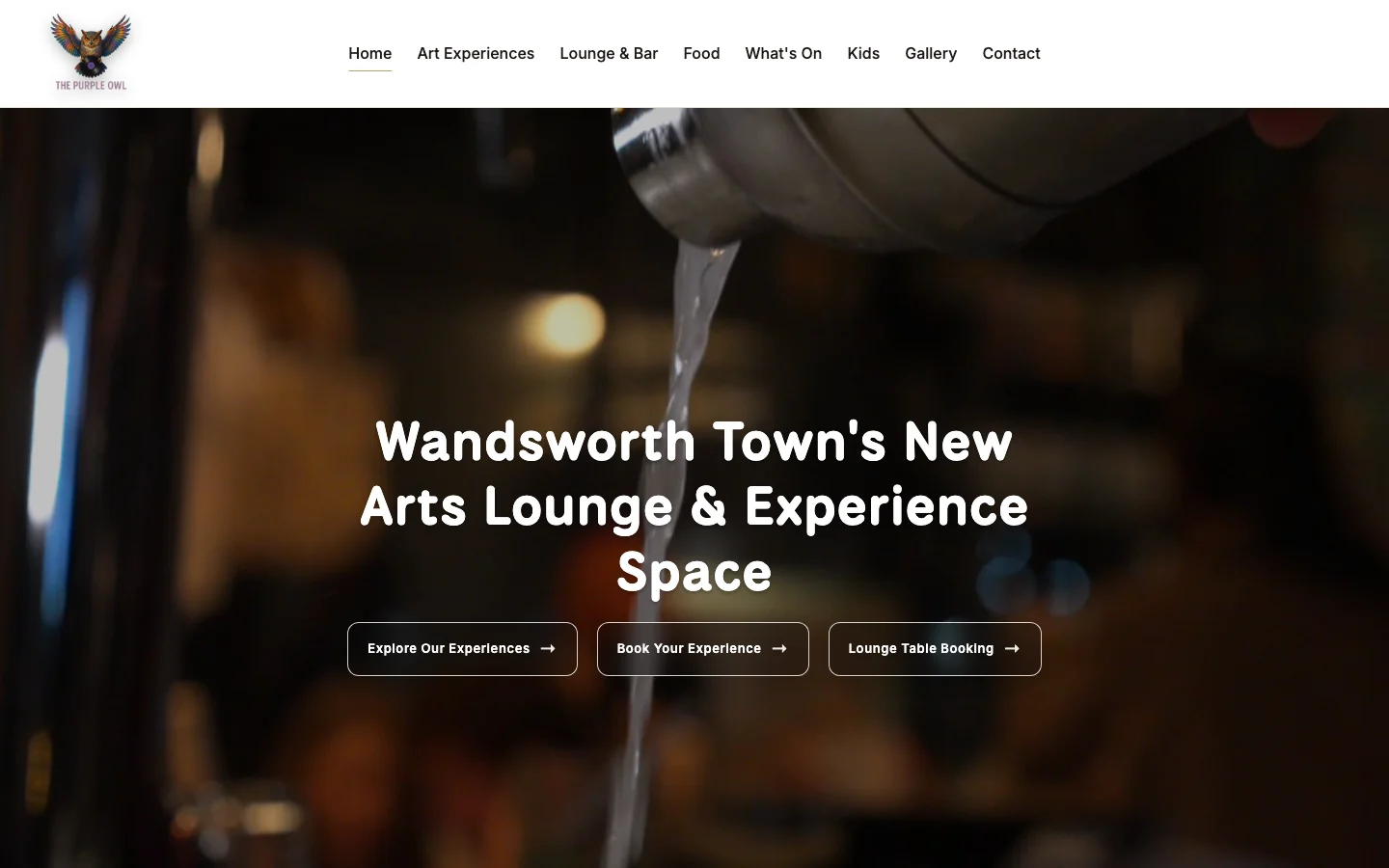
A venue offering workshops, food and drinks needs to help visitors choose the right kind of visit. On The Purple Owl website, creative sessions and lounge reservations have separate routes.
This case study looks at those visible design choices in a project from my portfolio. The booking-flow checks below are recommendations for reviewing a similar venue site.
One venue, several reasons to visit
The Purple Owl is an arts lounge and bar in Wandsworth, London. Its public website presents creative experiences alongside lounge visits, food, drinks and events.
That range creates a navigation problem. Someone choosing an activity needs different information from someone planning to meet friends for a drink.
I use this project to explain how a venue website can organize those intentions. The lessons come from the published pages reviewed on 17 October 2026, without attributing booking or revenue changes to the design.
Make the two main routes recognizable
The homepage gives experience booking and lounge table booking distinct labels. Its navigation also separates Art Experiences from Lounge & Bar.
That distinction lets the action explain its destination. Visitors can choose a creative session or a table before entering a booking flow, rather than interpreting a single general booking button.
For a similar brief, I would write the visitor's intention above each route in the sitemap: “I want to make something” and “I want somewhere to sit, eat or drink.” Then I would map the information each person needs.
The labels should stay consistent across navigation, offer pages and booking links. A new name halfway through the journey makes the visitor work out whether they have reached the same offer.
Make the activity page answer the next questions
The experience page distinguishes activities including canvas painting, pottery painting, clay moulding and fabric painting. It provides session and materials information alongside the offers.
The pottery offer, for example, separates the session charge from the pottery piece and explains collection. Other activities describe taking the finished item home. Those details affect what someone is committing to.
The design lesson is to give each activity its own decision information. A visitor should be able to understand the activity, what is included and how to choose a session.
For another venue, I would collect this information before drawing the activity layout:
- The activity name and who it suits.
- The duration and available booking pattern.
- What materials or equipment are included.
- Any separate charges or collection arrangements.
- The exact next step for an individual or a group.
Keeping these fields consistent makes offers easier to review and easier for staff to maintain. It also exposes missing content while the project can still address it.
Let lounge visitors make a different decision
The Lounge & Bar page brings menus and table reservations into one route. It distinguishes daytime and evening use and includes information about walk-ins.
The reservation section also separates standard table bookings from larger-group enquiries. A group with additional requirements can need a conversation before the venue confirms what is possible.
A table reservation should not appear to include an activity unless that is the actual offer. Equally, a creative-session booking needs to explain whether a separate table reservation is necessary.
For a new venue brief, I would ask the operator to resolve that relationship explicitly. The answer belongs near the booking action, where it can prevent an avoidable question.
Map the website and booking handoff together
The public pages show separate routes. A launch review should follow each one through the booking service as well. Navigation clarity is only one part of the complete task.
| Visitor intention | Information to present | Handoff to check |
|---|---|---|
| Book a creative session | Activity, duration, inclusions and relevant conditions. | The destination supports the selected activity and session choice. |
| Reserve a lounge table | Menus, visit information and reservation options. | The destination handles table availability and party size. |
| Arrange a larger visit | Group requirements and the appropriate contact route. | The request reaches the team with enough detail to respond. |
This table is a reusable planning tool. It does not assert that I tested completed payments, availability management or every third-party booking state on The Purple Owl site.
For a new integration, define where responsibility changes between website and provider. Confirm what can be passed through, what the guest must enter again and who handles errors.
Plan checks around real visits
Use a test environment or an operator-approved test when a journey would create a reservation or payment. Review these scenarios on a phone and with a keyboard:
- A first-time visitor chooses an activity and finds what is included.
- A lounge visitor finds the menu and the table-booking route.
- The requested date has no availability.
- A larger group needs help instead of an ordinary reservation.
- A booking destination fails to load or a visitor returns to the website.
Photography needs its own review. Activity images should explain what guests do; room images should show the space. Check the mobile crop so the subject remains useful at a smaller size.
Agree who updates menus, offers and visit information. Give that person a short list of pages to check when something changes, including any matching details held by the booking provider.
For reporting, distinguish visits to an offer, booking starts and confirmed bookings. If access to the provider only permits measuring an outbound click, report it as a click.
Use this approach for your own venue
Begin with the main reasons people visit. Give each one an offer page, the details needed to decide and an appropriate next action. The design can express one venue while supporting several distinct tasks.
The wider hospitality website guide covers photography, mobile use and handover. This case study focuses on separating experience and table-booking journeys.
If you are planning a venue site, send your offers, booking provider, menus and the questions staff answer repeatedly. See my web-design service or discuss your venue website.
Source pages: The Purple Owl homepage, Art Experiences and Lounge & Bar, reviewed 17 October 2026. Portfolio imagery illustrates the project; the live site's offers and presentation can change.